- info@zusto.com
- Free shipment from €50 (Belgium & Netherlands)
- Secure payment
- 100% happiness guarantee




The Hazelnut Spread That Changed the World — And What Comes Next
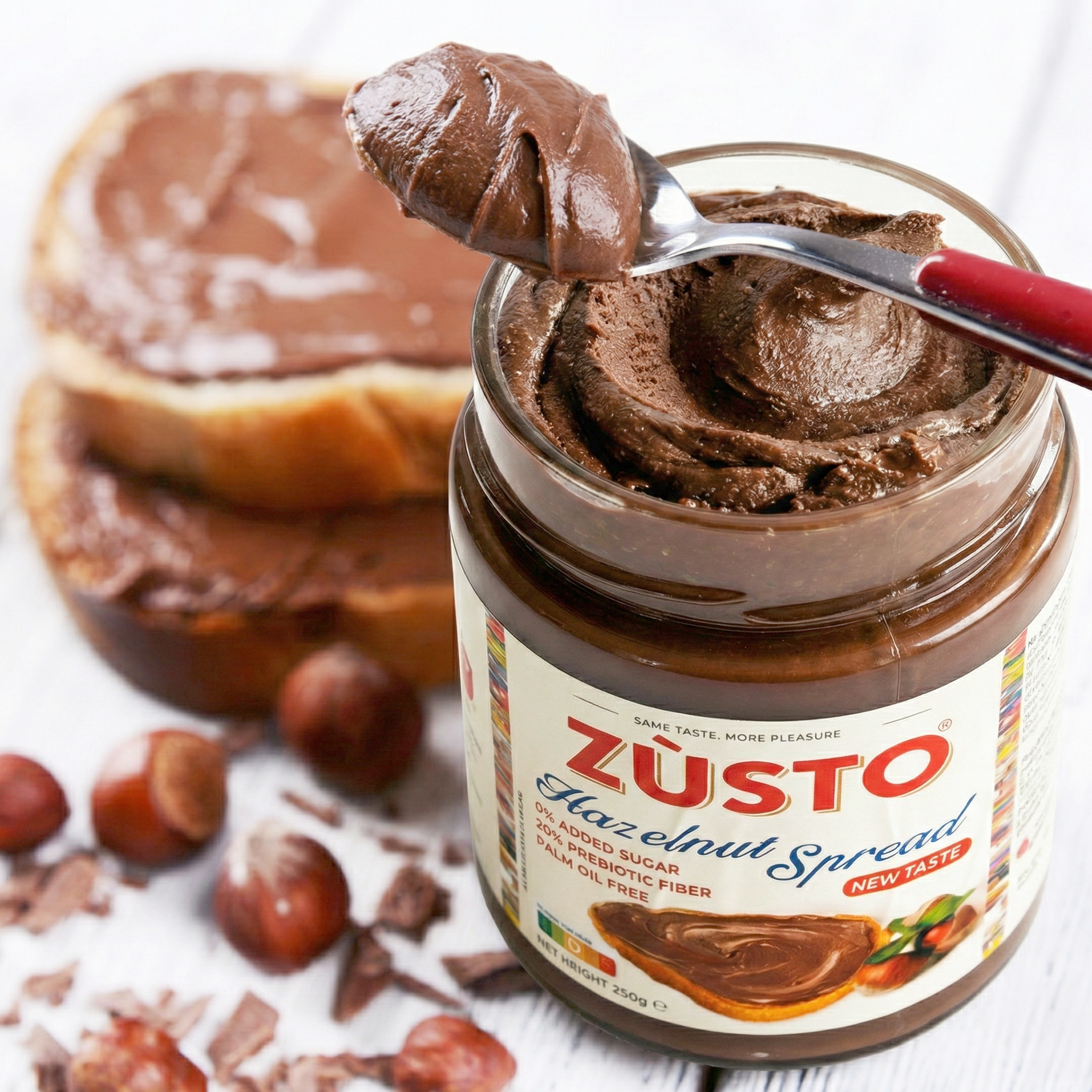
What actually makes Zùsto's Hazelnut Spread different — and honest answers to the two questions you keep asking. 89% less sugar, 65% prebiotic fiber, no palm oil.

A love letter to Nutella. And an honest explanation of why we made something different.
It Started With a Baker and a Shortage
In 1946, a baker named Pietro Ferrero had a problem.
Post-war Italy was recovering. Cocoa was scarce, expensive, almost impossible to source in meaningful quantities. But Pietro had something his hometown of Alba, in Piedmont, had in abundance: hazelnuts.
So he did what great food makers do — he improvised. He blended roasted hazelnuts with what little cocoa he could get, added sugar, and created a paste he called Pasta Gianduja. It was sold as solid blocks that you’d slice onto bread.
His son Michele took it further. He made it creamy, spreadable, and renamed it. On April 20, 1964, the first jar of Nutella left the factory in Alba.
It became one of the most iconic food products in history.
Why Nutella Deserves Respect
This isn’t a hit piece. Let’s be clear about that.
Nutella didn’t just create a product — it created a category. Before Pietro Ferrero’s invention, “hazelnut spread” didn’t exist. He solved a real problem with real creativity, and the result brought joy to millions of families across generations.
There’s a reason Ferrero uses 25% of the world’s hazelnut supply. There’s a reason Italy issued a commemorative stamp for Nutella’s 50th anniversary. There’s a reason the jar is in nearly every kitchen in Europe.
Nutella earned its place. Full stop.
Then Came the Imitators
The success of Nutella inspired exactly what you’d expect: hundreds of brands trying to replicate it. Cheaper versions, store brands, “just as good” alternatives — all chasing the same formula. More sugar, more palm oil, more of the same.
And the premium alternatives? Most went in the same direction, just with fancier packaging. Better branding, same playbook.
Even the wave of “sugar-free” and “healthier” hazelnut spreads that followed in recent years — at ISM Cologne 2026, the world’s largest confectionery trade fair, over 870 products were displayed under the sugar-free banner — mostly just swapped sugar for maltitol. A sugar alcohol with a glycemic index of 35–52 that’s so commonly associated with digestive issues, the EU requires a laxative warning on the label.
Different label. Same shortcuts.
We Asked a Different Question
When we created Zùsto’s Hazelnut Spread, we didn’t start by asking “How do we make a better Nutella?”
That question leads you down the same path every imitator has walked: tweak the recipe, match the texture, compete on shelf space.
We asked something else: What would a hazelnut spread look like if it was designed around what your body actually needs — without giving up what your taste buds want?
That question led us to fiber.
Fiber-First: A Fundamentally Different Approach
Zùsto’s Hazelnut Spread is built on 65% prebiotic fiber — the same proprietary formulation at the heart of everything we make.
Here’s what that means in practice:
- 89% less sugar than conventional hazelnut spreads (approximately 5.6g per 100g vs. Nutella’s 56g)
- No palm oil — which means the texture is sometimes firmer, and we’re completely fine with that
- No maltitol — none of the sugar alcohols that other “sugar-free” brands rely on
- A glycemic index of 22 — for context, a ripe banana is around 51
- Nutri-Score C vs. Nutella’s D
Is it a perfect replica of Nutella’s silky, effortless spread? No. And it was never meant to be.
The Texture Question (Let’s Be Honest)
You’ve probably seen the comments. “Why is it so hard to spread?” — fair enough. Our ambassador Chloe made a whole video about it, and she’s funnier about it than we could ever be in a blog post.
Here’s the honest answer: when you remove palm oil — which is what gives conventional spreads that ultra-smooth, effortless glide — you get a product that sometimes needs a moment to warm up.
That’s not a flaw. That’s what real ingredients behave like.
A few tips:
- Keep it at room temperature (the fridge makes it firm up)
- A warm water bath for a couple of minutes works beautifully
- Toast your bread first — warm bread does half the work
- Or just eat it straight from the jar. We won’t judge.
Not Better at Being Nutella. Better at Being Something Else.
Pietro Ferrero created Nutella out of necessity and ingenuity. He made something joyful from limited resources.
We respect that origin story. We’re not trying to replace it.
What we are doing is answering a question that didn’t exist in 1946: What if a hazelnut spread could be genuinely good for your gut, keep your blood sugar stable, contain no palm oil, have almost no sugar — and still be something you reach for because it tastes incredible?
That’s not a competition with Nutella. That’s a different category altogether.
Too many brands have tried to make hazelnut spread better by making it more like Nutella. We made it better by making it better for you — as satisfaction, as enjoyment, as something your body and your taste buds can agree on.
Enjoyment. Beyond Sugar.
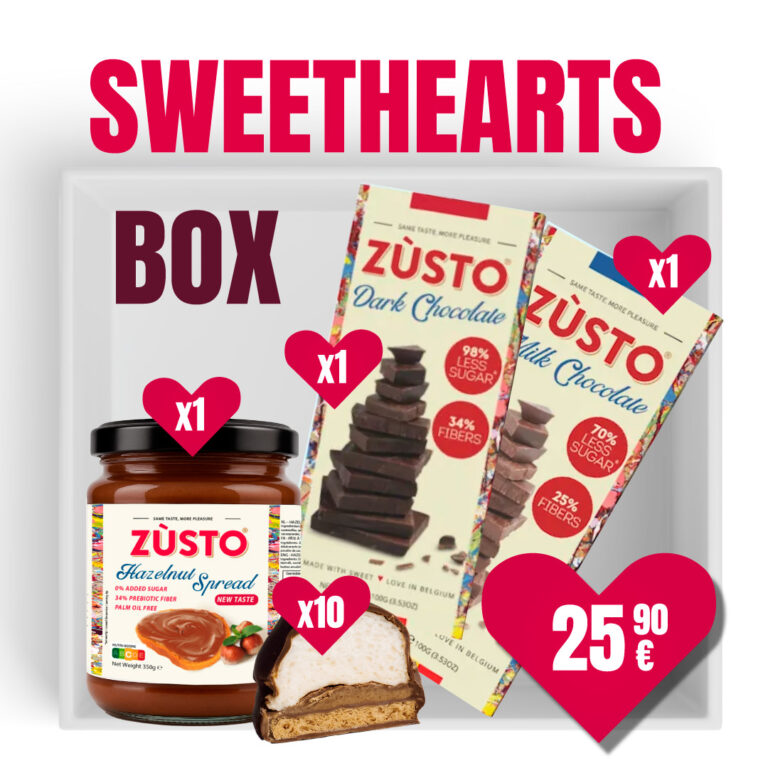
Watch Chloe’s honest take on the Hazelnut Spread here. Try it yourself and discover more of our range — from Dark Chocolate and Dubai Chocolate to Melocakes and our sugar substitute.