- info@zusto.com
- Free shipment from €50 (Belgium & Netherlands)
- Secure payment
- 100% happiness guarantee

Every week, new photos land in our inbox: golden sponge cakes with that familiar dome, dense fruit loaves studded with walnuts and raisins, brownies with a glossy top. The caption is almost always the same: “I swapped sugar for Zùsto and… it just worked.” If you’ve been wondering what actually happens when you make the switch, here are the four lessons our community keeps teaching us—straight from real ovens.
First, nothing about your recipe math changes—provided you weigh. When your card says 200 grams of sugar, you add 200 grams of Zùsto. That one‑to‑one swap by weight protects the chemistry you’ve already mastered: the way butter and sweetener cream to pale and fluffy, the way eggs emulsify without splitting, the way flour folds to a silky ribbon. Measuring by cups can mislead because different sweeteners have different densities; grams never lie. Put the bowl on the scale, tare to zero, pour to the number, and carry on.

Second, your cake still rises. Gas bubbles expand, protein networks set, and you get the same confident dome you expect from a well‑balanced batter. Bakers who were braced for a flat sponge are often surprised to see their layers lift as usual in the same pans at the same oven temperature and time. If anything, color can be a shade lighter on some bakes, which is your reminder to trust classic doneness cues—aroma in the kitchen, spring to the touch, a clean toothpick—over color alone.
Third, caramelization isn’t gone; it’s simply gentler. That appetizing bronze edge on a loaf, the toasty notes on a cooling sponge, the subtle chew around a cookie’s rim—all still show up. For glazes and sauces, a tiny splash of milk or cream and a pinch of salt at the end restore the glossy finish and round off sweetness in a way most palates love. It’s a small, pro‑level move that turns “nice” into “bakery.”

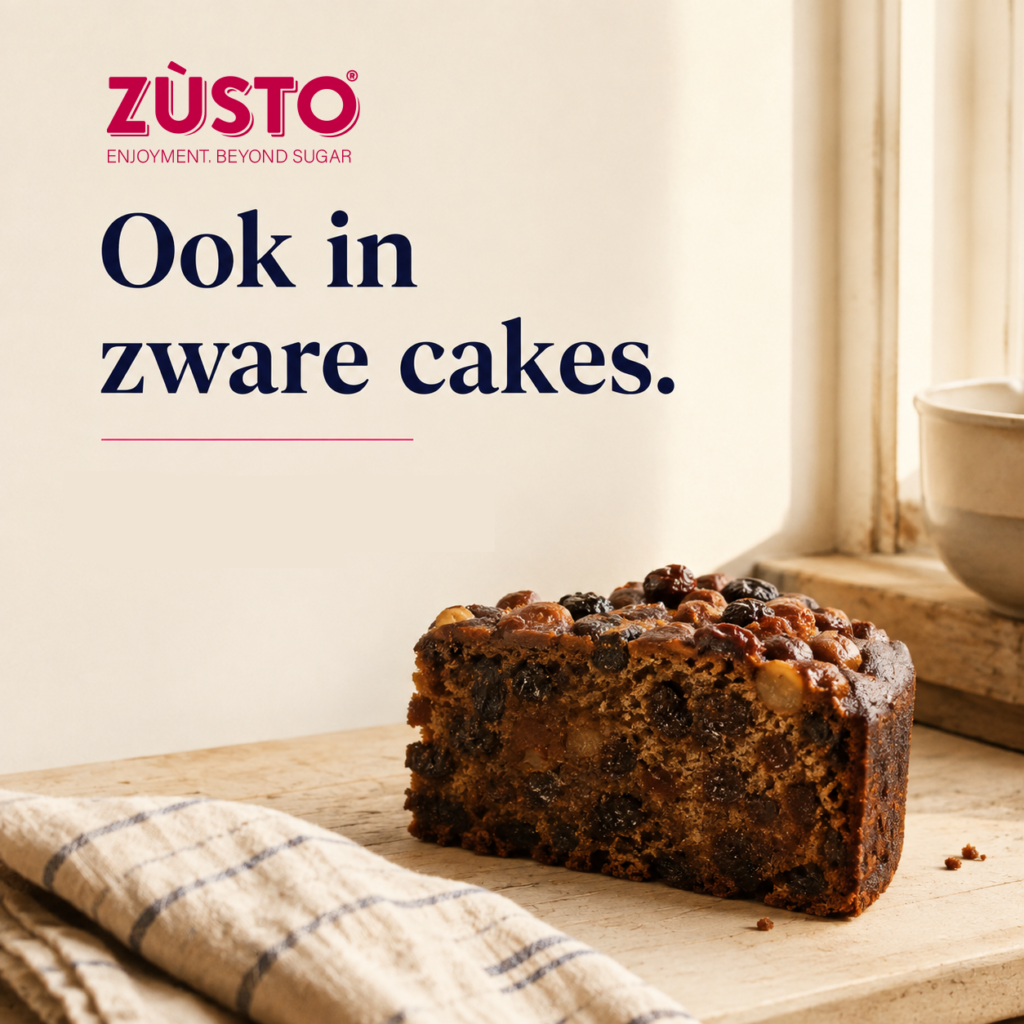
Fourth, “even the heavy stuff” behaves. Fruitcake, banana bread, carrot loaf—batters loaded with nuts, dried fruit, or purées—come out set, sliceable, and satisfyingly moist. The structure holds; the crumb is cohesive without being gummy; the top takes on that familiar, gently lacquered sheen. Fold in your mix‑ins just to combine, bake to internal cues rather than color, and let the loaf rest before slicing for the cleanest cut.
Under the hood, what makes these outcomes repeatable is simple design: Zùsto starts with a fiber‑first base—65% prebiotic fibers—then layers in a calibrated sweetening system to deliver sugar‑like taste with about 75% fewer calories than sugar and a measured glycemic index around 22 (table sugar is roughly 65). In everyday terms, that means you keep the pleasure and many people report a steadier “after,” especially when sweets are enjoyed with or after meals and paired with a glass of water. As with any fiber‑rich change, ease in and listen to your body; very high intakes can feel new for some at first.
So, what have you baked with it? If you’re Zùsto‑curious, start where confidence is highest: your go‑to sponge or banana bread. Swap sugar 1:1 by weight, keep your oven exactly as it is, and pull by aroma and spring. Snap a crumb shot when it cools—we never get tired of those—and tell us what surprised you most.
Same recipe. Same rise. Same caramelized edge. A gentler landing. And still entirely yours.